Why most SEO roadmaps fail in month two (and how to fix yours)
The keyword research is usually fine. The sequencing is what breaks. Here is the order we use so SEO shows progress before stakeholders lose patience.
Most SEO roadmaps look convincing in the kickoff deck and stall by the second month. The keyword research is usually sound and the content ideas are reasonable. What breaks is the order of the work. Teams publish new articles onto a site Google does not fully trust yet, then wait for rankings that arrive months later, if at all.
Here is the sequence we use for every SEO engagement, and why it produces visible progress early.
1. Start with the pages that already have equity
Before writing anything new, export every URL that earned impressions in Google Search Console over the last 12 months. You will usually find pages sitting in positions 8 to 20: close enough that Google already considers them relevant, far enough that they get almost no clicks.
Improving these pages is the fastest SEO win available. Rewrite the title to match the query people actually use, expand the content to answer the question fully, add internal links from related pages, and update the date only when the content genuinely changed. It is common to see these pages climb within a few weeks because the domain has already built some trust on the topic.
2. Fix technical debt before you scale content
Publishing forty articles onto a site with crawl and indexing problems is spending content budget to work around a technical issue. In the first two weeks we check:
- Indexing: pages excluded in Search Console, accidental noindex tags, and canonical tags pointing to the wrong URL.
- Duplicate content: filter, tag, and variant URLs that compete with your main pages.
- Speed: Core Web Vitals on mobile, especially Largest Contentful Paint and layout shift.
- Internal links: important pages that are more than three clicks from the homepage or have no internal links at all.
- Structured data: missing or invalid schema for products, services, articles, and FAQs.
This work runs in parallel with content planning, never after it.
Rankings are a lagging indicator. If they are the only number in your report, you will not know month three is failing until month five.
3. Sequence by intent, not by search volume
High-volume, top-of-funnel keywords look exciting in a keyword tool, but they are the slowest to rank and the least likely to convert. We start with bottom-of-funnel pages: service pages, comparison pages, pricing pages, and location pages. Someone searching for "emergency plumber in [city]" or "best CRM for small accounting firms" is ready to act.
Early wins on these pages produce leads, and leads keep everyone committed to the roadmap through the months before educational content starts to compound.
4. Report leading indicators every week
Rankings lag behind the work by weeks or months. We report on indicators that move first:
- Impressions for target queries in Search Console
- Click-through rate on pages we have rewritten
- Number of indexed pages versus submitted pages
- Leads and calls from organic traffic, tracked in GA4
When impressions grow but clicks do not, the title and description need work. When pages are not indexed, there is a technical or quality issue. These signals let you correct course in week three instead of month five.
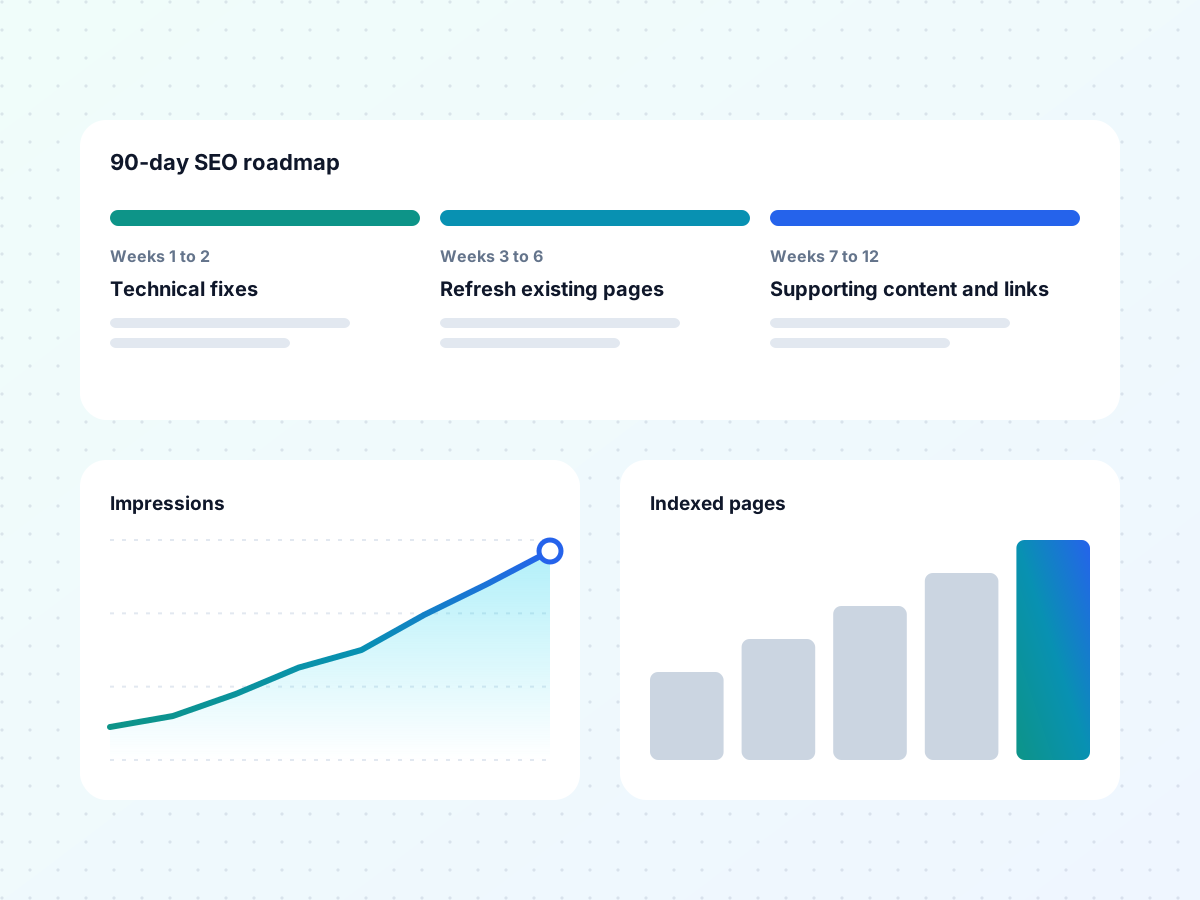
A simple 90-day SEO roadmap
Weeks 1 to 2: technical audit and fixes, Search Console review, and a list of pages with existing impressions.
Weeks 3 to 6: refresh the top ten existing pages and publish or improve core service pages.
Weeks 7 to 12: publish supporting content that links to those service pages and start earning links from relevant sites.
If your SEO has stalled, an audit of your Search Console data is usually the quickest way to see which of these steps was skipped. Book a free strategy call and we will walk through it with you.